

Your Guide to Canadian Government Funding Programs

If you're a Canadian business owner, you've probably spent countless hours mapping out your growth strategy. You know what you need to do—hire key people, invest in R&D, break into new markets. The big question is always, "How do we pay for it?"
For many, the answer lies in a powerful, yet often untapped, resource: government funding. We’re talking about non-dilutive capital. That means cash injections that don't force you to give up a single percentage of equity. It’s not just paperwork; it’s a strategic partnership designed to help your business—and the Canadian economy—thrive.
How Government Funding Can Transform Your Business
Think of these programs as a launchpad. They can give you the financial firepower to hire that senior developer you thought was out of reach, fund the R&D that leads to a breakthrough product, or finally execute that export plan. The support is there for the taking.
Demystifying the Funding Landscape
So, why does the government do this? It's simple: they're investing in the country's economic engine. Small and medium-sized enterprises (SMEs) are the lifeblood of our economy, creating the vast majority of private-sector jobs. When SMEs succeed, we all do.
This dashboard from Innovation, Science and Economic Development Canada paints a clear picture of just how critical SMEs are.

Understanding this "why" is the first step. When you frame your application as a contribution to this bigger picture—job creation, innovation, global competitiveness—you're speaking their language.
The funding itself generally falls into four main buckets, each designed for a different purpose:
- Grants: This is money you don’t have to pay back. It’s usually tied to a specific project, like developing a new technology or expanding your market reach.
- Loans: Think of these as business loans, but often with much better terms. You might find lower interest rates, more flexible repayment schedules, or government backing that makes you more attractive to traditional lenders.
- Tax Credits: These are a fantastic way to get money back for work you're already doing. They directly reduce your tax bill, rewarding activities like scientific research and experimental development (SR&ED).
- Wage Subsidies: Need to grow your team? These programs help cover a portion of a new employee's salary, often to encourage hiring students, recent graduates, or people from underrepresented groups.
When you stop seeing these programs as administrative headaches and start viewing them as accessible resources, you can build a much more robust financial strategy. The goal is to weave them into the very fabric of your growth plan.
This guide will walk you through it all. We’ll break down how to find the right programs for your business, what it takes to put together a winning application, and how to turn these opportunities into tangible results. Let’s get started.
The Four Flavours of Government Funding: A Practical Guide
When people hear “government funding,” they usually just think of free money. But the reality is much more nuanced—and frankly, much more interesting. The Canadian government offers a whole menu of support for businesses, and it’s not a one-size-fits-all situation.
Think of it less like a single treasure chest and more like a well-stocked workshop. You have four main tools at your disposal: grants, loans, tax credits, and wage subsidies. Knowing what each one does, and when to use it, is the first real step to securing the capital you need.
1. Grants: The Classic Cash Injection
This is what everyone wants, and for good reason. A grant is non-repayable funding. It's cash in your pocket that you don't have to pay back.
Because it’s essentially a no-strings-attached investment from the government, grants are laser-focused on projects that deliver a public good—things like creating high-value jobs, developing clean technology, or boosting Canadian exports. They want to see a clear return for the economy. This also makes them incredibly competitive. You’re not just asking for money; you’re pitching a project that has to be a perfect match for the program's very specific goals.
2. Government Loans: The Growth Partner
Don't dismiss a loan just because it’s not a grant. Government loans aren't like the ones you get from a bank. They're designed to be a strategic partnership to help you grow, often with terms you simply can't find anywhere else.
What makes them so powerful?
- Friendlier Interest Rates: The rates are almost always lower than what commercial lenders offer.
- Breathing Room to Repay: Many programs offer flexible repayment schedules, sometimes with interest-only periods, which is a lifesaver for your cash flow.
- Easier to Qualify: If your business is young, innovative, or just doesn't fit the rigid box a traditional bank uses, a government-backed loan can be the key to unlocking major capital.
These loans are perfect for big, tangible projects—buying that new piece of machinery you need, expanding your facility, or making a major inventory purchase to scale up.
It's easy to think grants are the only prize worth winning. But a low-interest, flexible loan can provide ten times the capital of a small grant, enabling the kind of transformative growth that truly changes the game for a company. It’s all about matching the tool to the size of your ambition.
3. Tax Credits: The Reward for Pushing Boundaries
Tax credits are one of the most powerful, yet most under-utilized, forms of funding out there. Instead of getting a cheque upfront, a tax credit reduces the corporate tax you owe at the end of the year. For a profitable company, that’s cash back in your pocket. For a startup that isn't profitable yet, many of these credits are refundable, meaning the government will actually send you a cheque.
The most well-known program is the Scientific Research and Experimental Development (SR&ED) tax credit. It’s designed to reward Canadian businesses for the R&D work they’re often already doing—solving technical problems, improving processes, and experimenting with new ideas. You can claim back a hefty percentage of your development team’s salaries and related costs. It’s a fantastic way to fund your innovation cycle.
4. Wage Subsidies: The Co-Investor in Your Team
Hiring great people is the fastest way to grow, but it’s also one of the biggest expenses. This is where wage subsidies come in. The government will co-invest in your team by covering a portion of a new hire's salary, making it much less risky to expand your workforce.
These programs are usually targeted to achieve specific outcomes, such as:
- Bringing in Young Talent: Programs like student work placements give you access to bright minds while giving them invaluable industry experience.
- Building Your Tech Bench: Subsidies often help offset the high cost of hiring skilled talent like software developers or engineers.
- Fostering an Inclusive Workforce: Some programs encourage hiring from underrepresented groups, helping you build a diverse and dynamic team.
By taking some of the financial weight off your shoulders, wage subsidies let you build the dream team you need to execute your vision.
To make it even clearer, here’s a quick breakdown of how these four funding types stack up against each other.
Comparing the Four Main Types of Government Funding
| Funding Type | What It Is | Best For | Repayment Required? |
|---|---|---|---|
| Grants | Non-repayable cash for specific projects. | High-impact projects aligned with government priorities (e.g., R&D, export, cleantech). | No |
| Loans | Repayable financing with favourable terms. | Large capital expenditures like equipment purchases, facility expansion, and scaling operations. | Yes |
| Tax Credits | A reduction in your corporate tax bill, often refundable. | Businesses consistently investing in innovation, research, and development. | No |
| Wage Subsidies | A subsidy to cover a portion of a new employee’s salary. | Growing your team, hiring students/interns, or bringing on specialized talent. | No |
Ultimately, the best funding strategy often involves a mix of these different types. Understanding how each one works is the key to building a plan that truly accelerates your company’s growth.
Finding Opportunities at Federal and Provincial Levels
So, where do you even start looking for Canadian government funding? The number of programs out there can feel overwhelming, but thankfully, it all boils down to two main levels: federal and provincial. Getting a handle on this distinction is the first real step to creating a search strategy that actually works.
Think of it like this: federal funding is the nationwide strategy, while provincial funding is the neighbourhood plan. Each has a different mission, a different pot of money, and its own set of priorities.
The Federal Funding Advantage
Federal programs are all about the big picture. Their goal is to lift the entire Canadian economy by fuelling innovation, pushing exports, and keeping us competitive on the world stage.
This means the programs are usually larger and open to businesses anywhere in the country. A tech startup in Vancouver can go after the exact same federal R&D grant as an advanced manufacturer in Halifax. It’s a level playing field, geographically speaking.
A few of the heavy hitters at the federal level include:
- Scientific Research and Experimental Development (SR&ED): This is a massive tax incentive program that essentially rewards Canadian businesses for doing their R&D work here at home.
- Industrial Research Assistance Program (IRAP): This is more than just money; IRAP provides both funding and expert advisory services to help small and medium-sized businesses get their tech to market.
- Canada Digital Adoption Program (CDAP): A program designed to help smaller businesses get online and adopt new digital tools to become more efficient and competitive.
Federal funding is typically your best bet for those ambitious, game-changing projects that align with Canada’s broader economic goals. This decision tree can help you map out which funding stream—federal or otherwise—makes the most sense for what you’re trying to achieve.
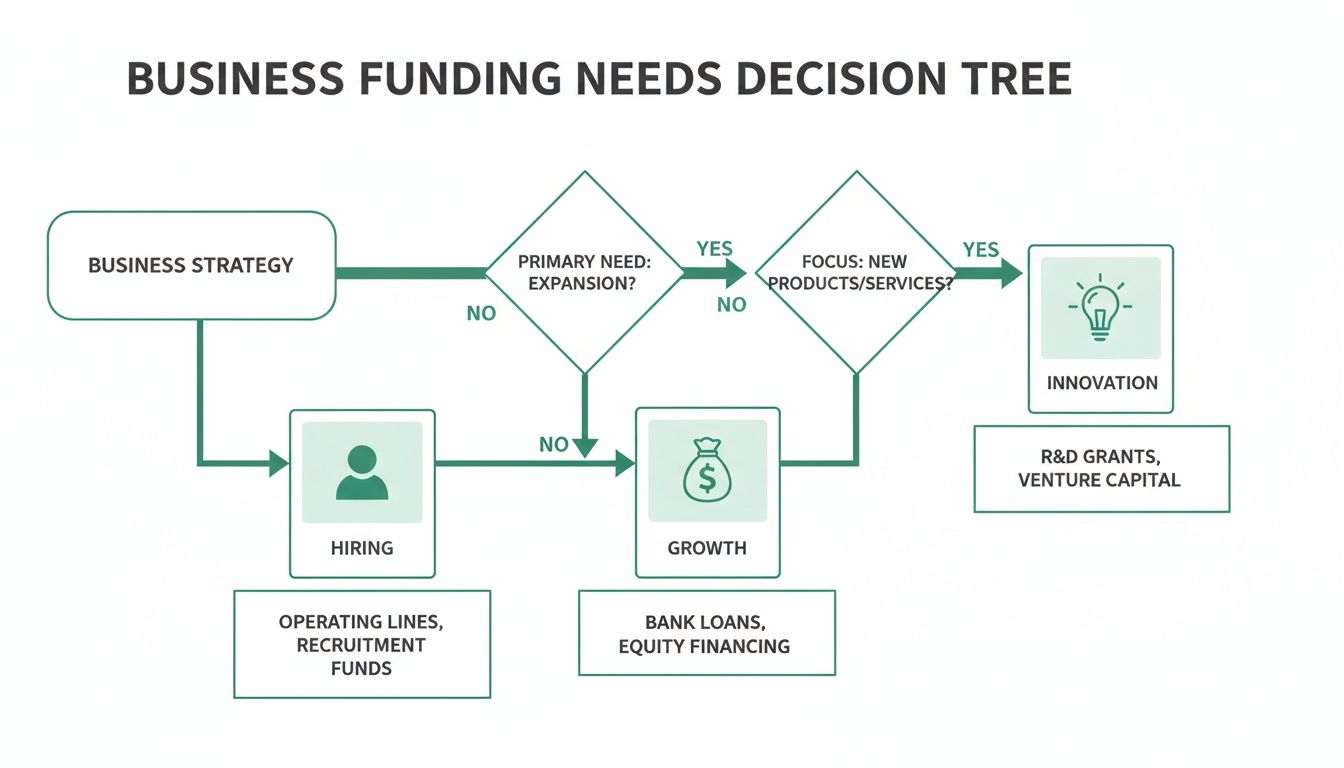
As you can see, different business needs—like hiring new talent, innovating, or expanding—point you toward very different funding pathways. It's a great way to start narrowing the field right from the get-go.
The Power of Provincial Programs
While federal programs look at the whole country, provincial programs zoom in. Their entire purpose is to spark economic growth in their specific region, create local jobs, and support the industries that form the backbone of that province or territory.
These programs are run by regional development agencies—think FedDev Ontario, PrairiesCan, or PacifiCan in British Columbia. Because their mandate is so localized, they can be a perfect match for projects that will make a real, tangible difference in your community.
Don't sleep on provincial opportunities. They're often less competitive than the big federal grants and are built specifically to tackle the unique economic challenges and advantages right in your own backyard.
Recent federal budgets have also put a huge emphasis on regional growth. For example, initiatives like the Communities Strong Fund are pouring over $50 billion over ten years into key provincial and municipal infrastructure projects like housing, hospitals, and schools.
Stacking Funding for Maximum Impact
Now, here's where things get interesting. You don't always have to choose just one. In many cases, you can "stack" funding from different sources. This means you could potentially combine a federal grant for innovation with a provincial loan for equipment and a municipal wage subsidy for new hires—all for the same project.
Of course, there are rules. Most programs have a stacking limit, which is a cap on the total percentage of project costs that can be covered by government money. If a program's stacking limit is 75% and you’ve already secured a federal grant that covers 50% of your costs, you can only chase another 25% from other government programs.
The key is to be completely transparent. You have to declare any and all government funding you’ve applied for or received. Hiding this information is a fast track to getting your application thrown out. For anyone based in Ontario, getting familiar with these provincial-level rules is a smart move. Our guide on finding an Ontario government grant is a great place to start.
By strategically pursuing both federal and provincial Canadian government funding programs, you can piece together a financial plan that dramatically cuts your project costs and speeds up your growth. The trick is to stop seeing them as separate pools of money and start using them as complementary tools in your funding toolkit.
Key Government Programs Every Business Should Know
Now that you have a handle on the different flavours of government funding, let's look at some of the heavy hitters. Hundreds of programs exist, but a handful of federal and provincial mainstays consistently deliver massive value to businesses across Canada.
Think of these as the major highways on the funding map. They’re well-established, well-funded, and built to support a huge range of activities, from bleeding-edge research to getting your business online. Getting to know these key players is the perfect starting point for your funding search.
Federal Funding Cornerstones
These programs are the federal government's backbone for driving a competitive and innovative economy. The great thing is, they’re generally open to eligible businesses from coast to coast.
Scientific Research and Experimental Development (SR&ED) Tax Incentive
This is, without a doubt, the single largest source of government support for R&D in Canada. It's not a grant you apply for upfront; it’s a tax credit you claim for the innovative work you’ve already done. It’s designed to reward businesses for pushing through technological roadblocks and advancing what's possible.
- Who it’s for: Any Canadian company doing eligible R&D work, from a two-person startup to a massive corporation.
- What it offers: A refundable tax credit of up to 35% on the first $4.5 million of qualified R&D expenses for Canadian-controlled private corporations (CCPCs). For larger amounts or other types of corporations, it’s a non-refundable credit.
- Why it’s powerful: It turns a big chunk of your innovation costs—like developer salaries or prototype materials—into cash you get back. That cash can then fuel your next big idea.
Industrial Research Assistance Program (IRAP)
Run by the National Research Council of Canada (NRC), IRAP is so much more than just a funding program. It’s a genuine partnership. It offers financial help, of course, but also connects you with expert technical and business advisors to help your small or medium-sized enterprise (SME) grow through innovation.
- Who it’s for: Incorporated, for-profit SMEs (that means fewer than 500 employees) that want to develop and commercialize new technologies.
- What it offers: Non-repayable contributions that usually cover 60-80% of your internal technical labour and any subcontractor costs for a specific innovation project.
- Why it’s powerful: You get an assigned Industrial Technology Advisor (ITA) who becomes an invaluable guide, providing industry insight right alongside the money you need to get your project moving faster.
Canada Digital Adoption Program (CDAP)
The government launched CDAP to help SMEs get online or adopt new digital tools to work smarter and compete harder. It's a direct response to the reality that being digital is no longer a "nice-to-have"—it's essential.
- Who it’s for: Small and medium-sized Canadian businesses looking to build their first e-commerce site or seriously upgrade their digital operations.
- What it offers: The program has two streams. One gives you a micro-grant for e-commerce adoption. The other offers a larger grant to build a full-scale digital adoption plan, which then unlocks an interest-free loan to put that plan into action.
- Why it’s powerful: It directly tackles a huge pain point for small businesses by providing both the capital and the expert advice needed to make a real impact online.
Provincial Programs Spotlight
While federal programs cast a wide net, provincial funding is laser-focused on regional economic goals. The amount of money flowing through provincial programs is staggering. Budgets in major provinces often set aside over $200 billion for total program spending, which includes everything from public services to direct business support. You can get a sense of this scale by digging into provincial financial reports.
Here are just a few examples that show how diverse this support can be:
- FedDev Ontario (Southern Ontario): This agency has a whole suite of programs aimed at helping businesses in Southern Ontario scale up, adopt new tech, and create jobs.
- PrairiesCan (Prairie Provinces): Covering Alberta, Saskatchewan, and Manitoba, PrairiesCan funds projects to help diversify the regional economy and boost businesses in growing sectors.
- PacifiCan (British Columbia): Focused squarely on B.C., PacifiCan invests in projects that fuel innovation, business growth, and stronger local economies.
- NGen Manufacturing Program (National/Manufacturing): While it's a national supercluster, NGen is a critical player for manufacturers. It offers non-repayable funding up to 44.4% of project costs for game-changing R&D in advanced manufacturing, a key industry in many provinces.
These programs are just the tip of the iceberg. Every province and territory has its own roster of funding opportunities, often targeting specific industries like agriculture, cleantech, or digital media. The trick is to look both nationally and locally to build a complete funding strategy.
Getting familiar with these flagship programs gives you a solid foundation. They represent real, tangible opportunities that have helped thousands of companies just like yours. Once you know what’s out there, you can start matching your business needs to the right programs. To explore more options tailored for new ventures, check out our guide on finding grants for small business.
A Smarter Way to Find and Apply for Funding
Knowing the different types of Canadian government funding is one thing, but actually winning it? That's a completely different ball game. This is where we shift from theory to action, because the path to funding is littered with common mistakes that can sink even the most promising application before it gets a fair look.
Far too many businesses take a scattergun approach, firing off applications for dozens of grants they barely qualify for and just hoping something sticks. Others submit weak, generic proposals that don't even try to connect their project to what the funder actually cares about. The result is always the same: hundreds of wasted hours and a string of demoralizing rejections. You need a better strategy.

The image above gets to the heart of what a modern, organized approach looks like. It’s about leaving behind messy spreadsheets and frantic, last-minute searches for a focused and intelligent process.
A Proven Workflow for Success
Instead of casting a wide, hopeful net, the most successful applicants follow a clear, systematic plan. This workflow makes sure your efforts are targeted, efficient, and much more likely to pay off.
Define Your Project First: Before you even glance at a single grant, you need to know exactly what you need money for. Is it for hiring a new software developer? Buying a specific piece of manufacturing equipment? Or launching a marketing campaign to crack the US market? A specific, well-defined project with clear goals and a realistic budget is the bedrock of any strong application.
Systematically Find Eligible Programs: Once your project is defined, the hunt begins for programs where you meet 100% of the eligibility criteria. This step is absolutely non-negotiable. Applying for funds you don’t technically qualify for is the fastest way to waste your time and the reviewers' time.
Craft a Compelling, Aligned Application: Your proposal needs to speak the funder's language. It must show, in no uncertain terms, how your project directly helps them achieve their goals—whether that’s creating jobs, sparking innovation, or boosting regional economies. Building a strong case is a crucial skill, and our breakdown of grant writing opportunities can help you nail it.
The Modern Solution: AI-Powered Platforms
Let’s be honest: manually managing this process is a monumental task. Sifting through hundreds of government websites, tracking deadlines in a spreadsheet, and writing every proposal from scratch is practically a full-time job. This is where modern, AI-powered platforms are completely changing the game for Canadian businesses.
Imagine having a system that not only finds the perfect funding opportunities for your business but also helps you write the application. That's the power of this new approach—it handles the grunt work so you can focus on strategy and telling your story.
These platforms work by matching your company’s profile against a constantly updated database of every available grant, loan, tax credit, and wage subsidy out there. They give you data-driven insights to prioritize the best-fit opportunities, saving you countless hours of mind-numbing research.
How GrantFlow Accelerates Your Funding Strategy
GrantFlow was built from the ground up to solve these exact problems. Think of it as an intelligent assistant that automates the discovery phase and simplifies the entire application process.
Here’s how it transforms your workflow:
- Automated Discovery: Instead of you doing the searching, GrantFlow brings the right programs directly to you, complete with a match score so you know immediately where to focus your energy.
- AI-Powered Writing: The platform helps draft tailored responses for your applications, turning what could be a weeks-long writing marathon into a matter of hours.
- Centralized Management: It’s your command centre for tracking deadlines, collaborating with your team, and managing multiple applications in one organized place.
This smarter approach lets you compete for funding more effectively and consistently. Even cornerstone programs like SR&ED are being modernized to drive more private-sector R&D, with recent updates projected to generate roughly $1.2 billion in annual economic output. Platforms like GrantFlow ensure you're perfectly positioned to capitalize on these evolving opportunities.
Answering Your Top Government Funding Questions
Diving into the world of Canadian government funding can feel a bit overwhelming, and it's totally normal to have a few questions. Let's tackle some of the most common ones that business owners ask so you can move forward with a clear head.
How Long Does It Take to Get Approved for Government Funding?
This is the big one, and the honest answer is: it really depends. There's no single timeline, as every program moves at its own pace.
A simple wage subsidy application, for example, might get the green light in just a few weeks. But for a more complex, multi-stage R&D grant like the Industrial Research Assistance Program (IRAP), you could be looking at several months from your first conversation to the final handshake.
Then you have tax credits like SR&ED, which are a different beast altogether. You claim those when you file your annual corporate taxes, so the whole assessment and refund process follows that schedule. The best thing you can do is check the specific program’s guidelines for their estimated processing times. It helps you set realistic expectations and bake the funding timeline right into your project plan.
One of the biggest mistakes I see businesses make is banking on funding arriving overnight. Always manage your cash flow as if the grant is a bonus, not a sure thing, and build in a buffer for potential delays.
Can I Apply for Multiple Government Grants at Once?
Yes, and honestly, you often should. This strategy is called stacking, and it's all about combining support from different government sources for the same project. Think of it like pairing a federal R&D grant with a provincial wage subsidy to cover more of your bases.
But, you have to play by the rules. Most programs have a "stacking limit," which puts a cap on the total percentage of a project's costs that can be covered by all government sources combined—that includes federal, provincial, and municipal funding.
For instance, if a program's combined government contribution limit is 75% and you've already locked in a federal grant covering 50% of your costs, you can only chase an additional 25% from other government programs. The key here is transparency. You must disclose any other funding you've applied for or received in every single application. Hiding this information is a surefire way to get disqualified.
What Are the Most Common Reasons Grant Applications Fail?
Grant applications get turned down for a handful of the same reasons, time and time again. Knowing what these tripwires are is the first step to sidestepping them and putting together a much stronger proposal.
Here are the most common culprits:
- Simple Ineligibility: This is, without a doubt, the number one reason. The company or project just doesn't tick the basic, non-negotiable boxes listed in the program guidelines.
- Weak Project Alignment: The application doesn't draw a clear, convincing line between what the project will do and what the funder wants to achieve. You have to spell out exactly how your project helps them hit their targets.
- An Incomplete or Rushed Application: Missing documents, shaky financial projections, or poorly written answers send a clear signal that you're not serious. It makes it incredibly easy for reviewers to put your file in the 'no' pile.
- Missing the Deadline: It sounds obvious, but you'd be surprised how often it happens. Deadlines for Canadian government funding programs are set in stone.
Success almost always boils down to doing your homework, tailoring each application to its specific audience, and making sure every single requirement is met with care and precision.
Do I Need to Hire a Consultant to Get Funding?
Hiring a consultant is definitely an option, but it's not a golden ticket to success. Plenty of businesses secure major funding all on their own by putting in the time to research programs, really understand the requirements, and write a compelling story.
The decision usually comes down to a classic trade-off: time versus money. Consultants bring a ton of expertise to the table and can save your team hundreds of hours, but that expertise comes with a price tag.
A modern alternative is now available that gives you the best of both worlds. AI-powered platforms like GrantFlow can equip your own team with the tools to find the right grants, draft solid responses, and manage the whole process from one place. This approach doesn't just save you money; it builds valuable expertise right inside your company, setting you up for repeatable funding success for years to come.
Ready to stop searching and start applying? GrantFlow uses AI to match your business with the perfect funding opportunities and helps you write winning applications in a fraction of the time. Discover the smarter way to secure government funding by exploring GrantFlow today.
Continue reading

Mastering Your 2026 Agenda for an Annual General Meeting
Draft a compliant agenda for an annual general meeting in Canada. Covers legal items, virtual meetings, & aligning your 2026 AGM with grant funding goals.
Grant Money for Disabled: A Canadian Funding Guide
Find grant money for disabled Canadians. Our 2026 guide covers federal & provincial benefits, business grants, eligibility, and how to apply successfully.

Home Improvement Grants Canada: A Complete 2026 Guide
Unlock Canadian home improvement grants in 2026. Our guide covers federal, provincial, and municipal funding for homeowners and businesses. Learn how to apply.